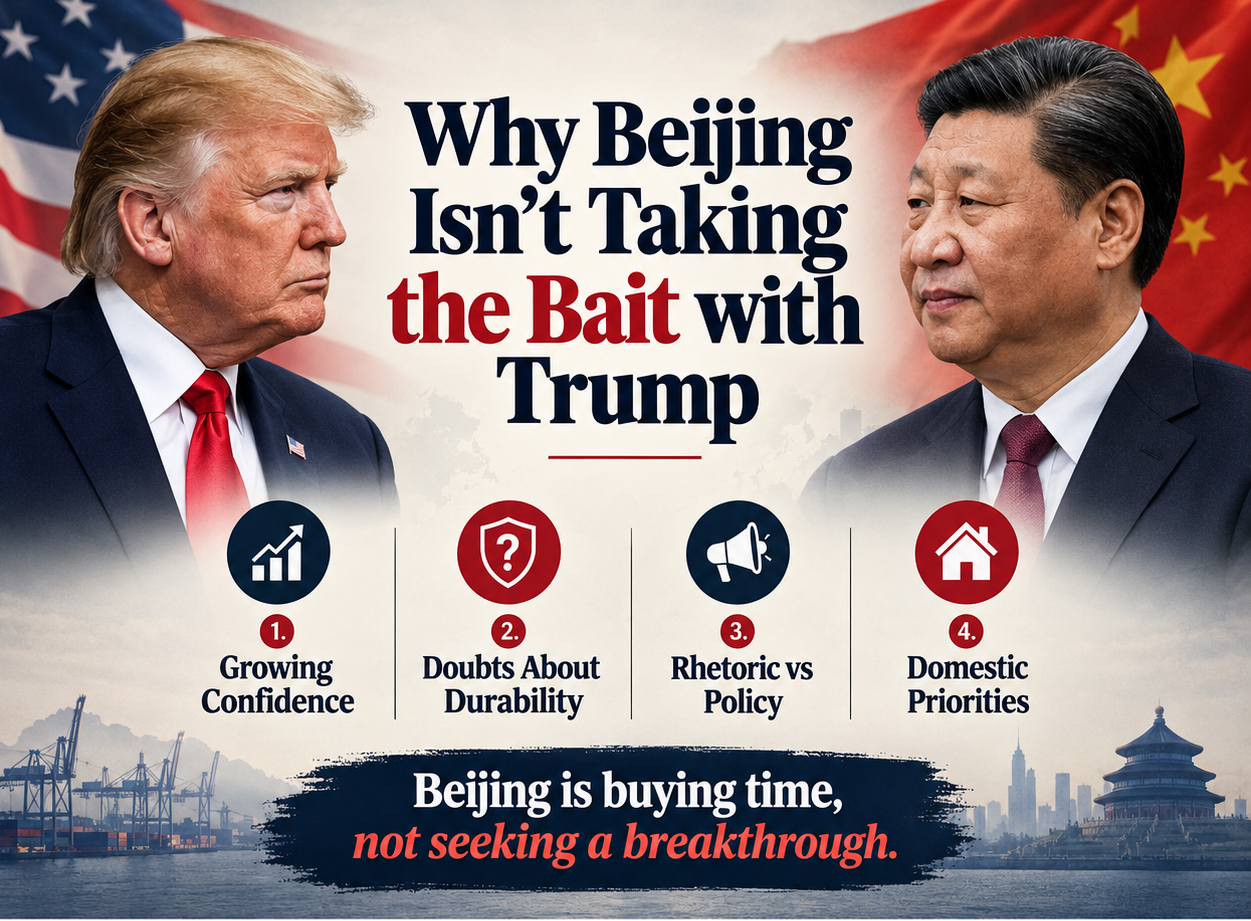
The relationship between the United States and China has entered a curious phase. President Trump has extended more warmth toward Chinese leader Xi Jinping than any American president in recent memory. He has eased technology restrictions, reduced the American military footprint near China's borders, softened long standing language on Taiwan, and repeatedly praised Xi in public. By most historical measures, this is exactly the kind of American posture that Chinese leaders have wanted since the founding of the People's Republic in 1949. Yet Xi Jinping has not responded with matching warmth. He has kept a composed, almost unreadable expression in public meetings, avoided grand declarations of partnership, and allowed his government to fall short on several trade commitments. This gap between American generosity and Chinese caution deserves a closer look, not only as a matter of diplomacy, but as a question of economics, national strategy, and global consequence. This article examines the issue from both the American and Chinese points of view, weighs the economic incentives on each side, and asks a harder question: does this uneasy calm actually benefit the rest of the world, or does it simply delay a larger reckoning between two great powers.
The Thinking Behind the US Approach
From Washington's point of view, the logic behind Trump's approach is largely transactional rather than ideological. Earlier American administrations, going back to the end of the Second World War, treated China policy as partly a moral project. They pushed Beijing toward political liberalization, supported human rights advocacy, and hoped that economic growth in China would eventually produce a more open political system. That approach largely failed to change China's governance model, and it created decades of friction without delivering the results Washington wanted.
Trump has abandoned that framework almost entirely. His administration does not link trade or diplomacy to human rights conditions. It treats China as a legitimate great power with its own political traditions rather than a project to be reformed. From an economic standpoint, this shift has clear justifications. American companies, particularly in agriculture, aviation, and semiconductors, have suffered under years of tariff conflict and market uncertainty. Farmers lost significant export volume during the trade disputes of Trump's first term. Boeing has depended heavily on Chinese aircraft orders to sustain its commercial production lines. Chip manufacturers such as Nvidia have lobbied hard for permission to sell advanced processors to Chinese buyers, since China represents one of the largest markets for computing hardware in the world. By easing restrictions and softening rhetoric, Trump is attempting to reopen these revenue streams for American industry while also reducing the trade deficit that he has long treated as a symbol of unfair economic competition.
There is also a security calculation behind this softening. Trump has shown skepticism toward the value of permanent alliances and forward military deployments, viewing them as costly commitments that produce limited direct benefit for American taxpayers. By reducing military assets near China and easing pressure on Taiwan related rhetoric, his administration hopes to lower the risk of direct confrontation while redirecting resources toward other priorities, including the war in the Middle East. In this sense, the American strategy is not naive generosity. It is a calculated bet that a less confrontational posture will produce more favorable economic returns and reduce the odds of a costly military crisis, even as other parts of the administration continue to pursue competitive measures such as export controls on Chinese drones and investment in supply chains for critical minerals.
Reading Beijing’s Position
China's caution can be explained through several converging factors, each with its own internal logic.
First, Chinese leaders now believe that time favors them. Beijing successfully weathered Trump's earlier trade war without making major structural concessions, and it managed to sustain economic growth during the global energy disruption caused by the conflict in Iran, partly because of its large domestic energy reserves and its rapidly expanding renewable energy sector. This experience has strengthened the belief among Chinese policymakers that China's relative economic and technological position is improving while America's position is weakening. If that belief is accurate or even partially accurate, it would be irrational for Beijing to rush toward concessions today when it expects to hold a stronger negotiating position tomorrow.
Second, Chinese officials remain skeptical that Trump's friendliness reflects a permanent shift in American strategy. They remember how quickly Trump moved from praising a trade agreement with China in early 2020 to blaming China for the spread of COVID nineteen later that same year. Given this history, Chinese leaders are cautious about building policy around promises that could reverse overnight, particularly since a large portion of the American national security establishment continues to favor a firmer approach toward China regardless of who occupies the presidency.
Third, there is a meaningful difference between Trump's public statements and the written strategic documents produced by his own government. Formal policy papers, including the administration's Artificial Intelligence strategy released in 2025, describe the goal of maintaining unquestioned global technological dominance. From Beijing's perspective, this kind of language reveals the deeper competitive intent of American policy, regardless of how warmly Trump speaks about Xi in public appearances. Chinese leaders appear to weigh institutional strategy more heavily than presidential rhetoric, since institutions tend to outlast any single administration.
Fourth, and perhaps most significantly, Xi Jinping is currently occupied by serious domestic challenges that limit his appetite for major new international commitments. An unprecedented anti corruption campaign has removed roughly half of the senior leadership within China's military command structure since 2022. This kind of internal purge tends to make officials cautious about proposing new initiatives, since standing out could expose them to political risk. At the same time, China is managing a slowing economy, elevated youth unemployment, and rising local government debt. Xi is also preparing for a fourth term as leader ahead of the twenty first Party Congress in 2027, which naturally draws his attention toward domestic political consolidation rather than foreign policy breakthroughs.
The Economic Case for Stability
Despite the caution on both sides, there are genuine economic benefits that help explain why neither country wants to abandon the current arrangement entirely.
For the United States, continued access to Chinese markets supports American agricultural exports, aviation manufacturing, and technology sales. A reduction in tariff related tension also lowers costs for American consumers and manufacturers who rely on Chinese components and materials. Stability in the relationship additionally reduces uncertainty for financial markets, which tend to react negatively to sudden escalations in trade conflict.
For China, continued access to American technology, particularly advanced semiconductors, supports its efforts to build competitive domestic industries in artificial intelligence and advanced manufacturing. Reduced tension with the United States also allows Chinese companies to maintain access to global supply chains and international investment, which remain important even as China pursues greater self sufficiency. A calmer relationship with Washington additionally gives Beijing more room to focus its resources on internal economic priorities rather than preparing for confrontation.
In short, the economic logic on both sides favors a stable, uneasy peace rather than either full cooperation or open conflict. Neither government currently possesses what economists call escalation dominance, meaning neither side can weaponize its economic leverage over the other without suffering comparable damage in return. This mutual vulnerability is itself a stabilizing force, since it discourages both governments from taking aggressive unilateral action.
The Broader Global Consequences
This is the more difficult question, and the honest answer is mixed.
There are real global benefits to the current calm. A reduction in open hostility between the two largest economies in the world lowers the risk of a severe global recession that could result from a full trade war or a military confrontation over Taiwan. Global supply chains, which touch nearly every country through manufacturing, shipping, and finance, benefit from predictability rather than sudden disruption. Smaller and developing economies, including many in Asia, Africa, and Latin America, often suffer the most when the two largest markets clash, since disruptions in trade flows and commodity prices tend to hit these economies disproportionately hard. In this narrow sense, the current stability is a global public good.
However, this benefit comes with limitations that should not be ignored. The current calm is not built on genuine cooperation or shared global leadership. Both countries continue to pursue competitive strategies aimed at reducing dependence on each other, whether in rare earth minerals, semiconductor manufacturing, or artificial intelligence infrastructure. Neither side has shown serious willingness to jointly address global challenges such as climate change, pandemic preparedness, or the safe governance of artificial intelligence, all of which would benefit enormously from coordinated leadership between the world's two largest economies. The absence of joint leadership on these issues represents an opportunity cost for the rest of the world, even if it is less visible than the benefit of avoided conflict.
There is also a fairness concern worth raising as a critical thinker. Much of the current calm depends on both governments prioritizing their own strategic advantage rather than global welfare. Smaller nations often find themselves pressured to choose sides or adjust their own policies based on decisions made in Washington and Beijing, without having meaningful influence over those decisions. A stability built primarily on mutual deterrence between two powerful states is fundamentally different from a stability built on shared rules and mutual accountability that smaller nations can also rely upon.
Synthesis of Findings and Overall Conclusion
Taken together, the evidence suggests that the current calm between the United States and China is a rational, self interested arrangement rather than a genuine partnership. Both governments benefit economically from reduced tension, and the world benefits indirectly from a lower risk of immediate conflict or economic shock. At the same time, this arrangement falls short of the kind of cooperative global leadership that could address shared challenges more effectively. It is best understood not as a solution to the rivalry between the two countries, but as a temporary and fragile pause that allows both sides to strengthen their own long term position. Whether this pause eventually leads to a more stable and rules based relationship, or simply delays a more serious confrontation, will depend heavily on decisions made well beyond the current terms of both leaders.
Would you like me to turn this into a formatted document file, such as a Word file or a PDF, so it is easier to save, print, or share separately from this chat?
 Practical Solutions
 Radical Ideas
 Radical Ideas
 Practical Solutions
Radical Ideas
Radical Ideas
Radical Ideas
Practical Solutions